All Blogs/Network
25 Jul 2026
3 min read

A Short History of Computer Networks: From ARPANET to the Modern Internet

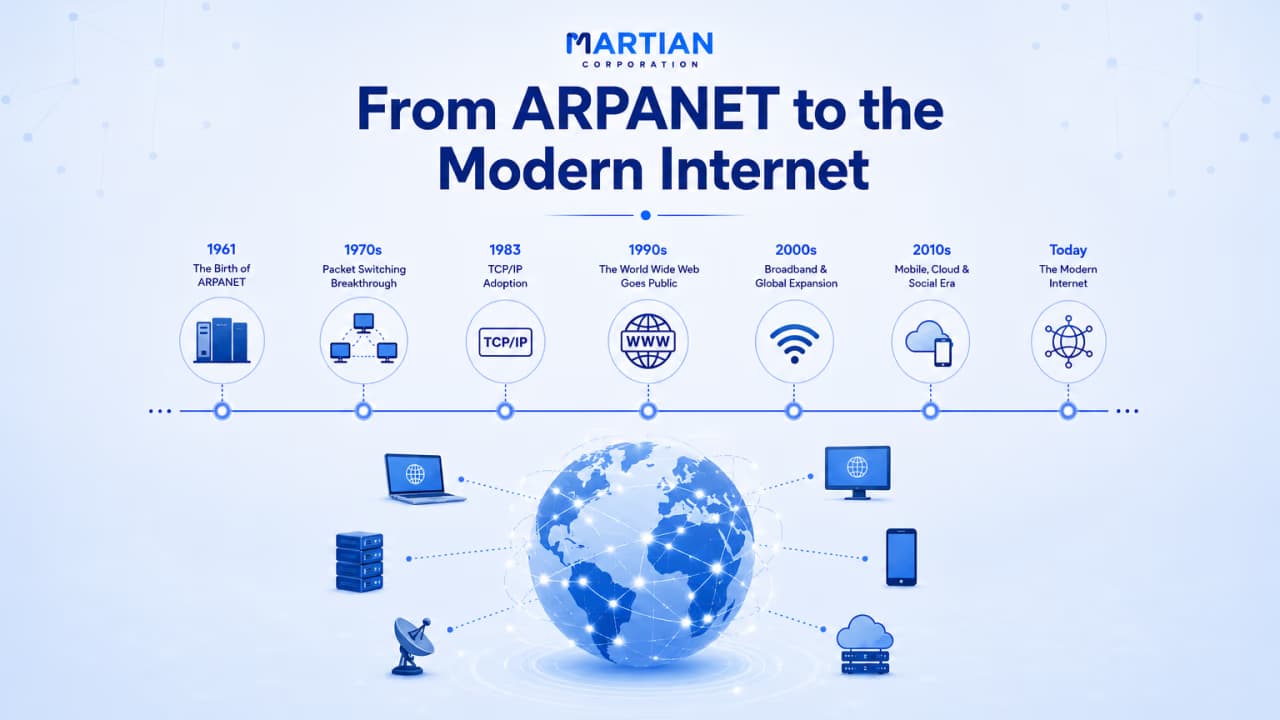
From ARPANET to the Modern Internet

By: Martian Corporation

Introduction 

“The internet was not born overnight. It was built one innovation at a time.” 

The internet is an inherent part of modern society. It surrounds us in our everyday lives, almost like electricity or roadways. However, it did not exist a mere century ago, and every webpage, search query, social media post, and digital transaction originates from concepts that have been innovated and improved over time. Specifically, the development of the modern internet involved numerous researchers attempting to address one central issue – how can computers effectively communicate over great distances? 

The internet that we know and use today is a product of many small contributions that made sense individually and combined to form something extraordinary. 

Where the Idea Began 

“Before there was an internet, there was a question.” 

In 1961, researcher Leonard Kleinrock proposed that data could be broken into small pieces, transmitted separately, and reassembled at its destination instead of being sent as one continuous stream. A few years later, Paul Baran and Donald Davies expanded this idea by introducing packet switching, allowing those pieces of data to travel through any available route rather than a single fixed path. This made networks more reliable and efficient, and laid the foundation for the modern internet. 
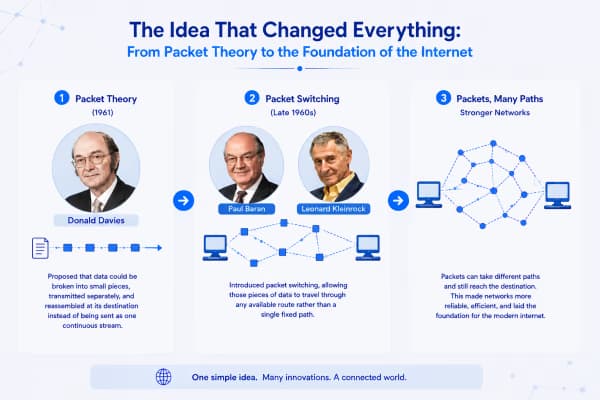
The Idea That Changed Everything: From Packet Theory to the Foundation of the Internet

The First Internet Message 

“The first internet message wasn't even a complete word.” 

On October 29, 1969, computers at UCLA and the Stanford Research Institute attempted to communicate over ARPANET, the world's first large packet-switched network. They intended to send the word "LOGIN," but the system crashed after the first two letters. The very first message ever transmitted was simply "LO." Despite its simplicity, it proved that computers in different locations could successfully communicate over a network. 

When Different Networks Became One 

“Separate networks are useful. Connected networks change everything.” 

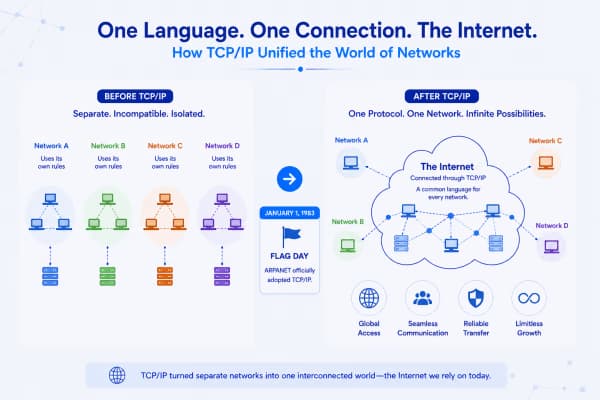
As more networks emerged, each followed its own communication rules, making it difficult for them to work together. The introduction of TCP/IP (Transmission Control Protocol/Internet Protocol) solved this by providing a common language for every network. On January 1, 1983, known as Flag Day, ARPANET officially adopted TCP/IP, allowing separate networks to function as one interconnected system—the beginning of what we now call the Internet

One Languae. One Connection. The Internet.

Making the Internet Easier to Use 

“People remember names, not numbers.” 

Early computers communicated using numerical IP addresses, which were difficult for people to remember. The Domain Name System (DNS) solved this by translating easy-to-read website names into IP addresses. Around the same time, NSFNET expanded networking beyond research institutions, connecting universities across the United States and helping the internet grow rapidly. Together, these innovations made the internet far more accessible and easier to scale. 

The Web Changed Everything 

“The internet already existed. The Web made it usable for everyone.” 

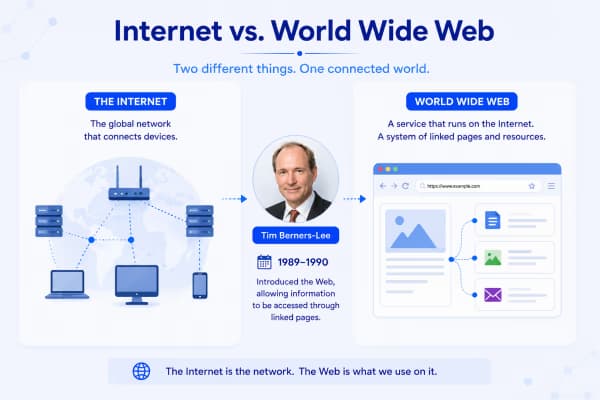
The internet and the World Wide Web are not the same thing. The internet is the underlying network, while the Web is a service that runs on top of it. Between 1989 and 1990, Tim Berners-Lee introduced the Web, allowing people to access information through linked web pages using a browser. This transformed the internet from a tool for researchers into something anyone could use.

Internet vs. World Wide Web

From Research Project to Everyday Life 

“Once businesses joined, the internet stopped being just an experiment.” 

During the 1990s, commercial internet providers opened the internet to the public, leading to the rise of websites, online shopping, and email. A decade later, smartphones, cloud computing, streaming platforms, and social media made internet access constant and portable. What began as a research project quickly became an essential part of everyday life. 

Looking Back 

“Every click today traces back to ideas developed decades ago.” 

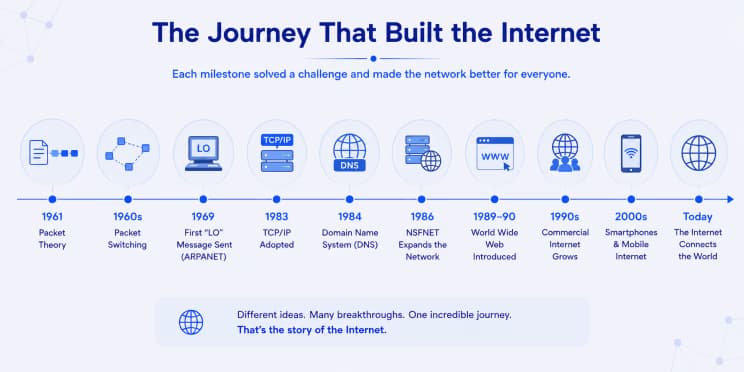
From packet theory and packet switching to TCP/IP, DNS, the World Wide Web, and mobile technology, each milestone solved a challenge while making networks more reliable and accessible. Understanding this journey helps explain why today's internet works the way it does and why many of its original design ideas are still relevant. 

The Journey That Built the Internet

NewsLetter

Stay ahead in the world of technology

Get curated technology trends, expert analysis, and product updates delivered straight to your inbox — no noise, just signal.

Enter your email address

By subscribing you agree to our Terms and Conditions and Privacy Policy

More Blogs

Switching & VLANsNetwork
28 Aug 2026
6 min read

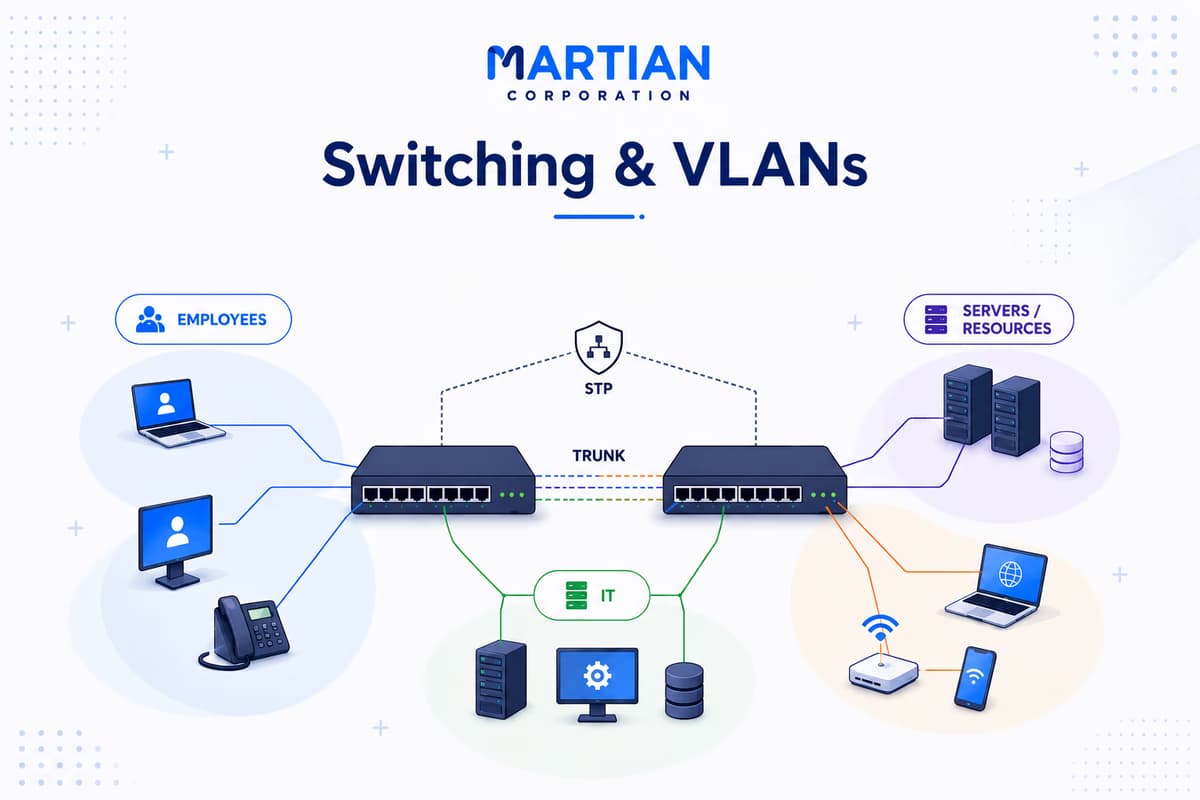
Switching & VLANs

Modern networks need more than simple connectivity—they need efficient traffic management, logical segmentation, and stronger security. Network switches make this possible by intelligently forwarding data between devices, while VLANs allow organizations to divide a physical network into separate logical networks. This article explores how switching works, how VLANs provide network segmentation, and how these technologies work together to build faster, more organized, and secure network infrastructures.

Read more
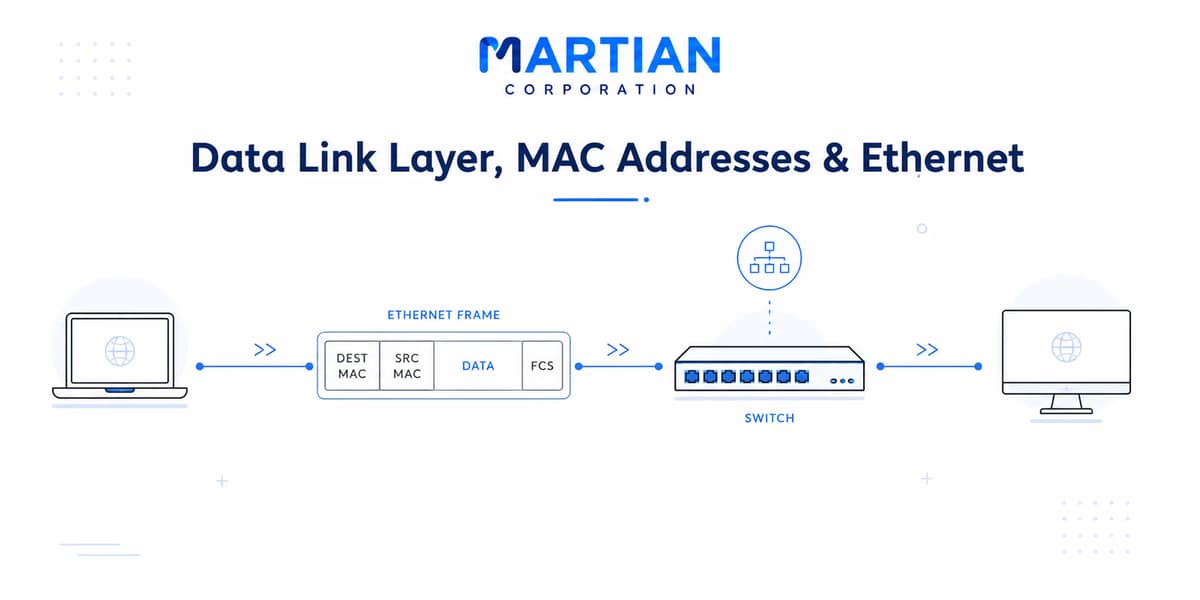
Data Link Layer, MAC Addresses & EthernetNetwork
26 Aug 2026
5 min read

Data Link Layer, MAC Addresses & Ethernet

Before data can travel across the Internet, devices must first communicate reliably within their local networks. The Data Link Layer plays a crucial role in this process by managing device-to-device communication through MAC addresses, Ethernet frames, switches, and error detection mechanisms. This article explores how the Data Link Layer works, how MAC addresses identify devices, and how Ethernet and network switches move frames across a local network—providing the foundation for efficient and reliable network communication.

Read more
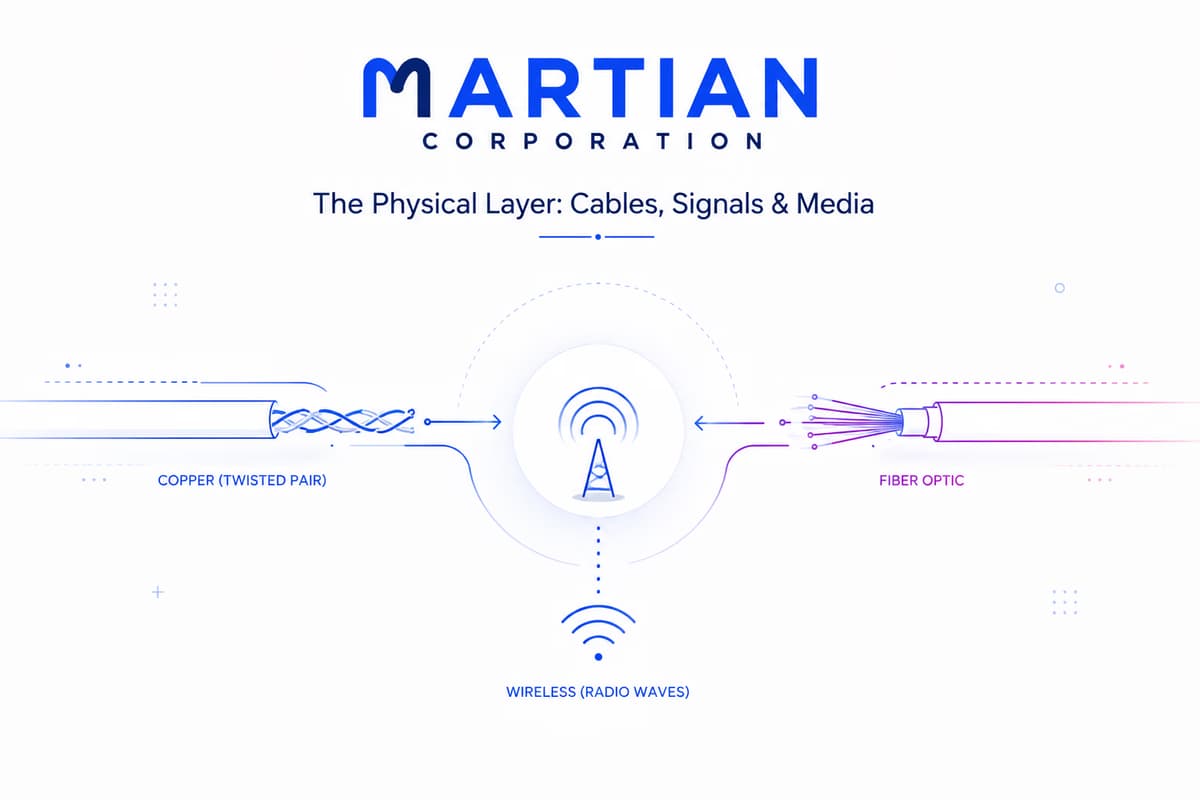
The Physical Layer: Cables, Signals & MediaNetwork
21 Aug 2026
5 min read

The Physical Layer: Cables, Signals & Media

The Physical Layer: Cables, Signals & Media Every network begins with something physical — electrical signals through copper, pulses of light through fiber, or radio waves through the air. In this article, we take a closer look at the Physical Layer of the OSI Model and understand how data actually travels between devices. We’ll explore copper cables, twisted-pair wiring, fiber optic communication, wireless networks, bandwidth, throughput, latency, signal encoding, connectors, and networking standards — the building blocks that make modern computer networks possible. Because before packets can be routed, addressed, or delivered, they first need a physical medium to travel through.

Read more